Textile history · European traditions
Flax and Wool in European Textile Tradition
One fiber comes from a field; the other from an animal. For centuries, European makers have brought flax and wool together, balancing linen’s cool, dry character with wool’s spring and warmth. The result is more than a practical blend. It is a record of climate, labor, trade, and the changing textures of daily life.
Published October 16, 2026
Run a hand across a linen-and-wool cloth and the contrast announces itself before the composition does. Linen can feel crisp and slightly cool, with a smoothness that gives way to the irregular character of its plant fibers. Wool tends to feel softer, more resilient, and warmer to the touch. Woven together, the two do not simply cancel each other out. They negotiate: one brings structure and a dry, breathable surface; the other adds loft, flexibility, and insulation.
That negotiation has deep roots in European textile history. Flax and wool were both familiar, useful fibers long before the modern throw became a decorative household layer. Their cultivation and processing demanded different kinds of work, and their availability varied with local landscapes and economies. In some places, flax was a household crop; in others, wool was tied to pastoral life, markets, and long-distance trade. A woven textile could draw on those parallel histories, whether the yarns were combined in one cloth or used side by side across a home.
Today, linen-wool blends make the relationship visible in throws, blankets, and other woven home textiles. Looking closely at fiber content, weave, weight, and finish offers a way to understand both how a fabric behaves and how longstanding material choices continue to shape contemporary design.
Two fibers, two different lives
Linen begins with flax, a cultivated plant whose stalks yield long fibers. Turning those fibers into yarn is a sequence of careful operations: the stalks are harvested and dried, the woody outer material is broken and removed, and the fibers are separated and prepared for spinning. The precise methods have differed over time and between regions, but the principle is consistent. A plant stem must be transformed into something long, flexible, and fine enough to become thread.
Wool begins with the fleece of sheep and requires another chain of skilled work. After shearing, fibers are sorted, cleaned, prepared, and spun. Their length, fineness, and crimp influence the resulting yarn. Wool fibers can trap air and recover from bending, qualities that help explain the familiar warmth and spring of wool cloth. Different breeds, local environments, and processing choices produce different kinds of wool; the word does not describe one uniform material.
These raw materials behave differently on the loom. Linen yarn is often strong and relatively inelastic. It can create a cloth with a clear surface and a composed drape, but its limited stretch can make handling and finishing distinctive. Wool is more elastic and can form a fuller, softer fabric. The exact effect depends on the yarn and weave, but the broad contrast helps explain why the fibers can complement one another.
Neither quality is a guarantee in isolation. A loose weave can feel airy regardless of fiber, while a dense structure can make a cloth more substantial. Finishing changes the hand, too. Washing, brushing, or other treatments may soften a textile, alter its surface, and affect how it hangs. The finished cloth is therefore the product of fiber, yarn, construction, and treatment working together—not a simple sum of the labels on its materials.
A landscape of work and exchange
European textile traditions were never a single, unchanging system. Climate, soils, land use, household organization, and access to markets all influenced which fibers people could obtain and how they used them. Flax could be grown and processed in agricultural communities; sheep could supply wool in regions where grazing was important. The balance between those resources varied considerably, as did the scale of production.
Textile making also connected the countryside to towns and trading centers. Fiber growers, animal keepers, spinners, weavers, dyers, and merchants each contributed to a material’s passage from raw resource to finished cloth. In some periods and places, tasks were distributed among specialized workers. Elsewhere, production remained closer to household use. The history of a fabric is therefore also a history of labor: time spent preparing fibers, spinning yarn, setting up a loom, and producing a piece that could serve for years.
Wool’s warmth made it particularly valuable in cooler conditions, while linen’s breathable character and ability to form a firm, washable cloth supported a range of domestic and clothing uses. But these distinctions should not be turned into rigid rules. People adapted materials to local needs, mixed fibers in different ways, and made choices based on availability, cost, function, and custom. A textile could be everyday equipment, a marker of status, a household inheritance, or a trade good—sometimes all at once.
For historians, surviving cloth can be an unusually intimate source. It carries evidence of technique in its yarns and weave, but also of use in wear, repairs, and changes made over time. A textile is not simply an illustration of the past. It is an object produced through decisions and labor, and one that continued to participate in daily life after it left the loom.
What a blend can—and cannot—tell us
A modern linen-wool textile can evoke historic material relationships, but it should not be mistaken for a direct replica of an older cloth. Contemporary production has its own machinery, standards, supply chains, and design priorities. Fiber percentages tell readers what materials are present, but not by themselves where the flax was grown, how the wool was sourced, who made the cloth, or what conditions shaped its production.
The proportions nevertheless offer a useful starting point. A blend with a substantial share of wool may feel warmer and more resilient than a linen-dominant cloth of similar construction. Linen can contribute a dry hand, visible texture, and a composed surface. But a percentage is not a complete performance forecast: yarn thickness, weave density, finishing, and the quality of the fibers all matter. Two textiles with similar content can drape and feel quite differently.
Weave gives another clue. In a plain weave, the crossing of warp and weft creates a straightforward, stable structure. Herringbone uses a broken twill pattern to produce a distinctive zigzag effect and a surface that catches light differently. A textile may also combine structures, changing pattern or density across its surface. These choices affect appearance, hand, and drape as well as the visual character of the cloth.
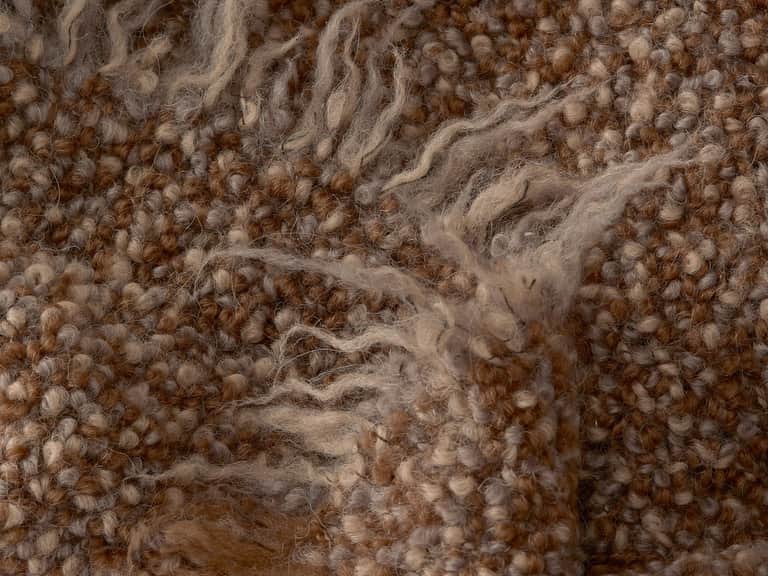
Finishing is part of the story, not a decorative afterthought. A washed or stonewashed finish can give fabric a more relaxed surface and softer feel. Fringe makes the yarn ends visible at the edge, while a hem encloses them. Neither tells the whole story of craftsmanship, but each is a practical and aesthetic decision that shapes how a woven piece reads in a room.
From woven cloth to the modern throw
The throw is a familiar object with a flexible purpose. It can add a light layer to a bed, offer warmth on a sofa, or introduce a patch of color and texture without changing an entire room. That versatility makes it a natural setting for material contrasts. A linen-wool throw can pair the drier, more structured impression of flax with wool’s softer warmth, while a mixed weave can make the contrast visible as pattern and surface.
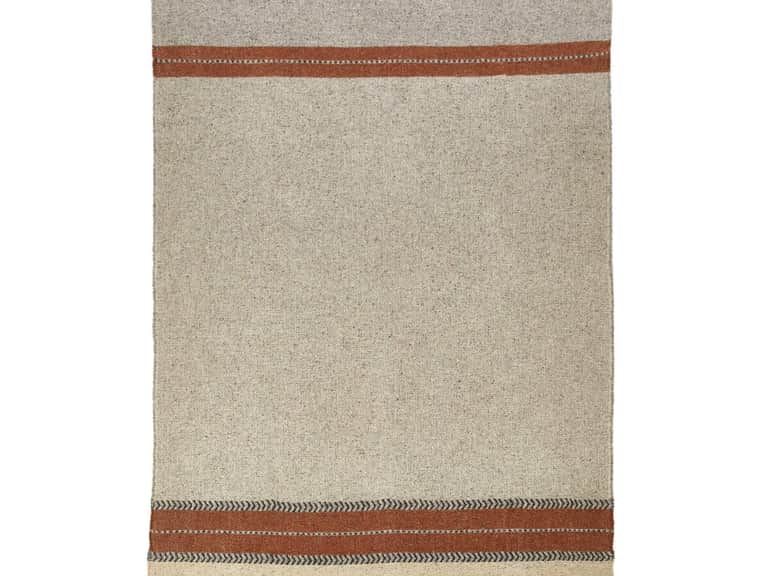
Consider the Montana Throw, a contemporary woven example made from 49% wool, 27% linen, 19% viscose, and 5% polyamide. Its herringbone and plain-weave construction, washed finish, and flax-colored fringe show how fiber content works alongside structure and finishing. The blend is not identical to a historical textile; rather, it makes an old material conversation legible in a current home object. Wool supplies the largest share, while linen contributes a substantial part of the composition.
At 24.4 ounces per square yard, the Montana Throw has a comparatively substantial listed weight. Its dimensions—51.2 by 86.6 inches—allow it to be used as a generous layer. The product information recommends washing at no more than 30°C on a wool or hand-wash program, unfolding it fully, avoiding an overloaded machine and chlorine bleach, and favoring line drying. Care instructions matter especially in a blended cloth: different fibers may respond differently to heat, agitation, and moisture.
Product details such as these are useful, but they should be read with care. A blend’s composition does not by itself establish that an item is sustainable, ethically produced, or locally made. Claims about origin and certification require specific evidence. The more precise the question—where the flax came from, how the wool was sourced, how the fabric was woven—the more important transparent documentation becomes.
Reading texture as a record of construction
Texture is often the first thing people notice in a woven home textile, but it is also a form of information. A smooth, close surface suggests a different construction from an open, irregular one. The alternating diagonal lines of herringbone make the order of the weave apparent, while plain areas can create a quieter counterpoint. Fringe exposes the ends of the cloth’s structure; a finished hem conceals them.
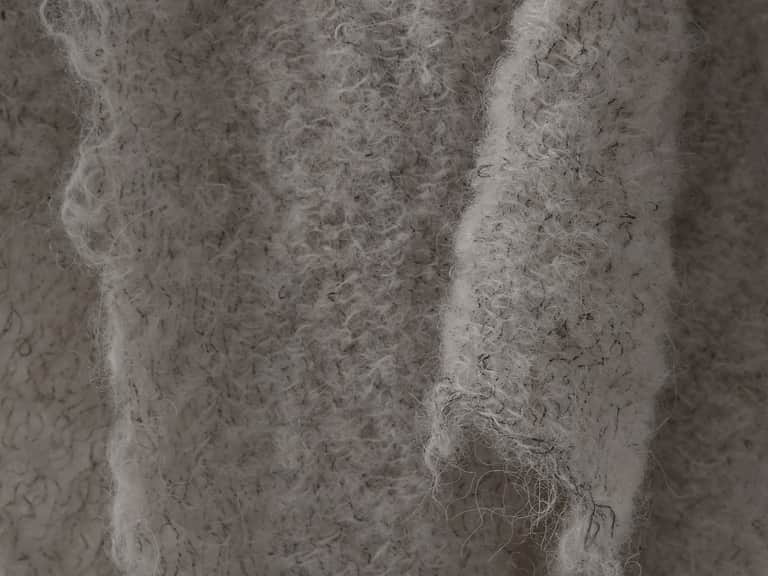
In linen-and-wool textiles, these details can heighten the fibers’ contrast. A washed finish may soften the impression of linen’s crispness. Wool can add body to a cloth that might otherwise feel more spare. A striped or plaid design can organize the surface into repeated bands, giving a large throw a sense of rhythm. The visual result is shaped not only by color but by the interaction of yarns and the way they cross.
That is why a fabric description should be more than a list of adjectives. “Soft,” “breathable,” and “warm” can help orient a reader, but they are not precise measurements. Construction, weight, dimensions, and care guidance offer more grounded evidence. Whenever possible, look for the full fiber composition and specific laundering instructions rather than relying on a broad label such as “natural blend.”
There is also value in accepting the irregularities of a material. Linen yarn can have variations in its surface; handmade or artisanal production may show differences in fabric and fringe. Such variation is not automatically proof of superior workmanship, nor is uniformity necessarily a flaw. It is best understood in context: what process produced the textile, what qualities were intended, and what the maker or seller explains about the object.
Care, longevity, and everyday use
Textile longevity begins with matching care to the material and construction. A linen-wool blend should not be treated as if it were pure cotton. Wool can be vulnerable to excessive heat and agitation, while linen may crease and can respond to washing and drying in ways that change its surface. If a care label specifies a wool or hand-wash cycle, that instruction takes precedence over general advice. When the label recommends line drying, a dryer may introduce unnecessary risk of shrinkage or distortion.
For routine care, first check the maker’s instructions and the textile’s condition. Avoid harsh bleach unless the label explicitly permits it. Use an appropriate detergent and a gentle program when machine washing is allowed. Give a large throw room to move in the drum, and reshape it carefully after washing if needed. If the material is valuable, delicate, or has uncertain care requirements, professional advice may be wiser than experimentation.
How a throw is used matters, too. Frequent friction can cause wear, particularly at edges and corners. Rotating a textile between uses, folding it rather than dragging it across rough surfaces, and storing it clean and dry can help preserve its appearance. Care is not a promise that a fabric will remain unchanged. It is a way to extend its useful life while allowing natural fibers to acquire the softness and character of use.
The household has always been a place where textiles are tested. A cloth must function through seasons, movement, washing, and contact with furniture and people. The appeal of a linen-wool throw lies partly in that practical dimension: it is not merely an abstract reference to heritage, but a working object whose qualities become meaningful in use.
A material history still in progress
Flax and wool remain compelling because their differences are so clear—and because the choices involved in combining them are never purely technical. They connect agriculture and animal husbandry, hand skills and industrial production, local resources and international trade. In a single woven cloth, those broad histories can meet at the scale of a room, a bed, or a chair.
To read a linen-wool textile well is to look beyond the label. Ask what each fiber contributes, how the weave is built, what the finish changes, and how the piece is intended to be cared for. A herringbone pattern, a washed surface, and a flax-colored fringe are not history in themselves. They are contemporary design choices that can echo older textile traditions while belonging to their own time.
That distinction is important. Europe’s textile past was varied, shaped by different communities and working lives, and cannot be reduced to a single story of timeless craft. Yet material knowledge travels. The understanding that flax can give a cloth clarity and breathability, while wool adds warmth and resilience, has enduring practical force. In today’s woven home textiles, the relationship persists—not as a museum piece, but as a fabric made to be handled, used, and lived with.
A quick guide to linen-and-wool textiles
- Check the composition. Fiber percentages clarify what is in the cloth, but do not alone determine its feel or performance.
- Look at the construction. Plain weave, herringbone, and other structures affect texture, drape, and visual pattern.
- Read the finish. Washing and other treatments can soften or alter the surface.
- Follow the care label. Blended fibers may respond differently to heat, agitation, and drying.
- Keep historical claims specific. A contemporary blend can draw on longstanding material traditions without being a direct reproduction of a historic textile.
The story of flax and wool is ultimately a story of complementary properties and human choices. Their meeting in a woven throw brings a long history of European textile knowledge into everyday reach—one fiber, one crossing, one useful layer at a time.